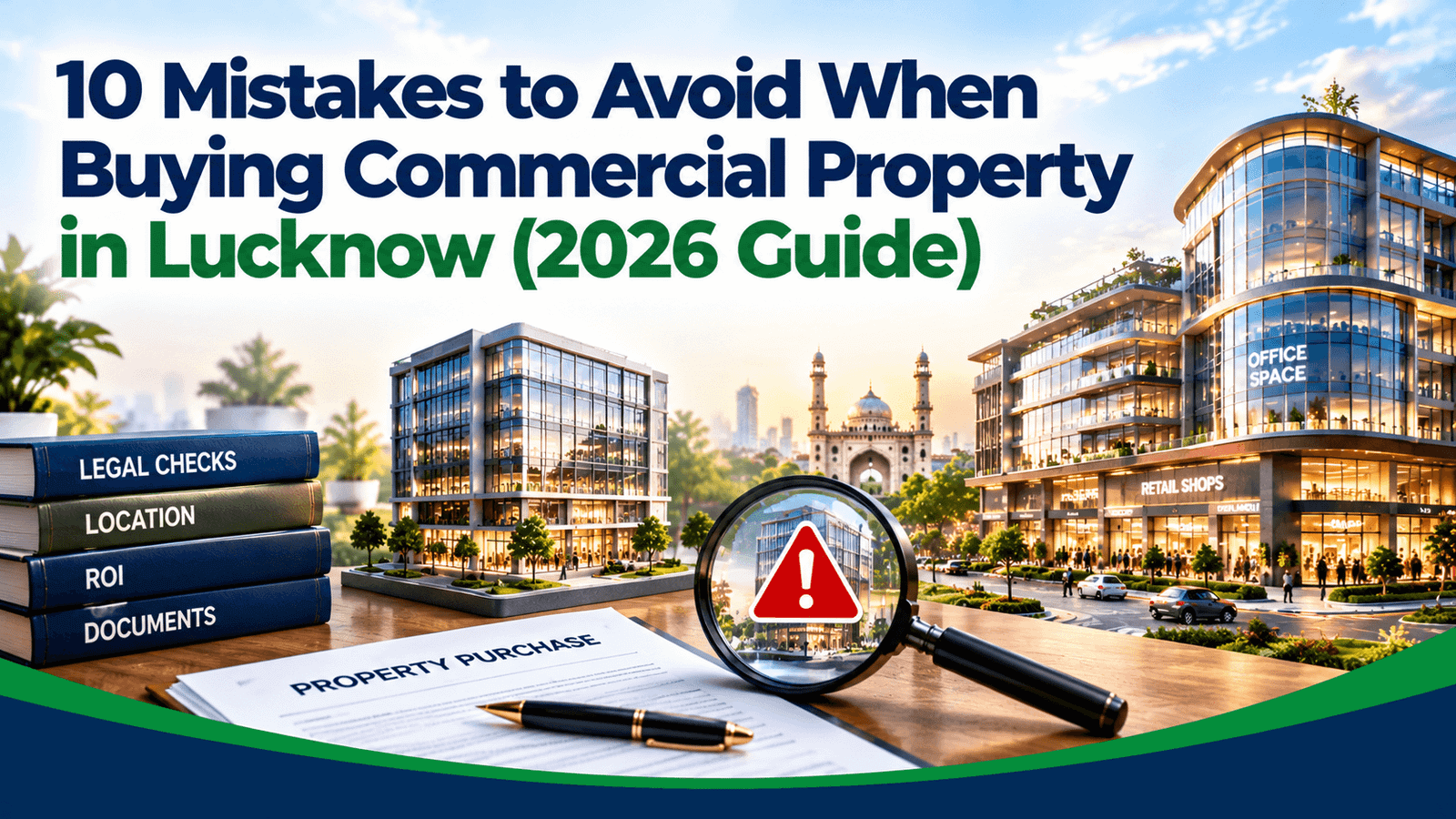
Buying a commercial property in Lucknow can be an important financial decision. Whether you are considering a retail shop, an office space, a showroom, or a commercial unit in a business development, the right property can support your business plans and long-term financial goals.
However, purchasing commercial real estate involves more than selecting an attractive location and negotiating a price. Buyers must evaluate legal documentation, property approvals, accessibility, tenant demand, maintenance costs, and potential rental income before making a commitment.
One overlooked detail can lead to unexpected expenses, extended vacancy, legal complications, or difficulties selling the property later.
If you are searching for commercial property in Lucknow, understanding these risks before purchasing can help you make a more informed decision.
Lucknow offers a variety of commercial property options across locations such as Gomti Nagar, Gomti Nagar Extension, Sushant Golf City, and the Shaheed Path corridor. Each location has different commercial characteristics, and the suitability of a property depends on its precise location, configuration, pricing, and intended use.
At Mozart Realty, buyers can explore commercial property listings and compare available options according to their requirements.
In this guide, we explain the 10 most common mistakes to avoid when buying commercial property in Lucknow, along with practical steps to help you evaluate your options more carefully.
Why Is It Important to Avoid Mistakes When Buying Commercial Property in Lucknow?
Commercial real estate purchases can involve substantial upfront costs and ongoing financial commitments.
Unlike a residential property purchased primarily for personal use, a commercial property may depend on business activity, tenant demand, customer access, and the financial performance of the surrounding commercial area.
For example, a retail shop may have limited commercial appeal if customers cannot easily access it. Similarly, an office in a building with poor maintenance or inadequate parking may struggle to attract suitable tenants.
Commercial property buyers should therefore consider three essential factors:
- Financial feasibility: Does the total cost fit your budget, and are the expected returns realistic?
- Legal security: Are the ownership documents, approvals, and transaction terms satisfactory?
- Commercial suitability: Is the location and property configuration appropriate for the intended business or tenant?
Understanding these factors can help buyers avoid preventable problems and compare properties more effectively.
1. Choosing a Commercial Property Without Researching the Location
One of the biggest mistakes buyers make is selecting a commercial property based on the locality’s reputation alone.
A well-known commercial area does not guarantee that every shop or office within it will perform well.
Two properties in the same neighbourhood can have very different commercial prospects because of their visibility, road access, surrounding businesses, parking facilities, and customer traffic.
Why Location Matters
Commercial properties depend on the needs of the businesses that occupy them.
A retail shop may benefit from visibility and pedestrian movement, while an office may place greater importance on connectivity, parking, and a professional working environment.
When researching commercial property in Lucknow, consider the following areas as starting points for comparison:
Gomti Nagar: An established commercial district with offices, retail establishments, restaurants, and professional services.
Gomti Nagar Extension: An area where buyers can investigate commercial developments and surrounding residential catchments.
Sushant Golf City: A developing real estate area where individual commercial projects should be assessed for occupancy, accessibility, and tenant demand.
Shaheed Path corridor: An area worth investigating for commercial developments and connectivity, depending on the exact project location.
These areas offer different property environments. None should be treated as a guarantee of rental income or price appreciation.
How to Avoid This Mistake
Visit the property in person before making a decision.
Observe the area during different times of day and, where relevant, on weekdays and weekends.
Check:
- Road connectivity and approach routes
- Parking availability
- Visibility from nearby roads
- Nearby residential communities
- Existing commercial establishments
- Public transport accessibility
- Competing commercial properties
- Current occupancy within the development
Ask local property professionals about comparable units and actual rental activity.
Mozart Realty tip: Compare the exact property location rather than choosing solely by the locality’s name.
2. Ignoring Legal Documents and Property Title Verification
Another serious mistake is proceeding with a commercial property purchase without independently verifying its legal documentation.
A property may look attractive and have a competitive price, but buyers still need to establish whether the seller has the right to sell it and whether the property meets the relevant legal requirements.
Legal due diligence is especially important when purchasing commercial units in larger developments.
Documents to Check Before Buying Commercial Property
Depending on the property and transaction, relevant documents may include:
- Title deeds and ownership records
- Previous conveyance documents, where relevant
- Encumbrance and outstanding liability information
- Approved building plans
- Applicable land-use permissions
- Completion or occupancy certificates, where required
- Applicable fire and safety approvals
- Property tax and maintenance payment records
- Sale agreement and payment terms
- Relevant project registration and disclosures
Not every document applies to every property. An independent property lawyer should determine which records are necessary for the specific transaction.
Check Applicable RERA Registration
For projects covered by the Real Estate (Regulation and Development) Act, 2016, buyers should verify the relevant registration and disclosures.
You can use the official UP RERA project verification portal to check registration details.
RERA registration does not replace independent title verification or guarantee investment returns.
Buyers should also review project status, applicable approvals, and relevant disclosures before proceeding.
How to Avoid This Mistake
Do not rely exclusively on verbal assurances from a seller, broker, or developer.
Arrange an independent legal review before signing binding documents or paying a substantial advance.
Remember: A property’s appearance and marketing materials cannot establish that its title and approvals are satisfactory.
3. Underestimating the Total Cost of Buying Commercial Property
Many buyers focus on the advertised property price without calculating the complete purchase cost.
This can create financial pressure when additional expenses arise during registration, possession, or property setup.
For example, a commercial unit listed at ₹60 lakh may require additional funds for registration-related charges, legal verification, maintenance deposits, interior work, or financing expenses.
The exact costs depend on the property and transaction.
Additional Expenses to Consider
Stamp duty and registration charges: Applicable charges should be verified through the relevant Uttar Pradesh government resources.
GST: Tax treatment depends on the transaction and property status. Confirm the applicable treatment with a qualified tax professional.
Maintenance charges: Commercial developments may require recurring maintenance payments or advance deposits.
Parking costs: Parking may be included in the quoted price or charged separately.
Legal fees: Independent document verification and agreement review may involve professional charges.
Interior and fit-out expenses: A shop or office may require additional work before occupation or leasing.
Loan-related expenses: Financing may involve processing fees, interest, and other applicable charges.
Property management expenses: If you intend to rent out the unit, management and upkeep costs can affect returns.
How to Avoid This Mistake
Prepare a complete property acquisition budget before shortlisting properties.
Ask the seller or developer for a written breakdown of the quoted price and additional charges.
You can also consult the official Uttar Pradesh Stamp and Registration Department for relevant registration services and stamp duty calculation resources.
Do not commit your entire available budget to the purchase price alone. Keep an appropriate reserve for transaction expenses and unexpected costs.
4. Buying Commercial Property Without Assessing Rental Demand
Some buyers purchase commercial real estate primarily because they expect to earn rental income.
However, a property’s rental potential depends on actual demand, not simply the developer’s projected returns or the locality’s reputation.
A commercial unit may remain vacant if its location, size, price, or configuration does not suit prospective tenants.
What Determines Commercial Rental Demand?
Several factors can influence the likelihood of attracting a tenant:
- Accessibility and connectivity
- Visibility and frontage, where relevant
- Unit size and layout
- Parking and building facilities
- Nearby businesses and residential catchments
- Competition from comparable properties
- Maintenance standards
- Permitted commercial use
- The rent expected by the owner
For example, a retail shop may require convenient customer access, while an office may need suitable utilities, lifts, security, and parking.
Calculate Rental Yield Carefully
Rental yield is a useful starting point for evaluating an investment.
The formula for gross rental yield is:
Gross Rental Yield = (Annual Rental Income ÷ Property Purchase Price) × 100
Suppose a commercial property costs ₹50 lakh and generates ₹25,000 in monthly rent.
Annual rental income would be:
₹25,000 × 12 = ₹3,00,000
Gross rental yield would be:
₹3,00,000 ÷ ₹50,00,000 × 100 = 6%
This is a hypothetical example, not a rental estimate for any particular property in Lucknow.
Gross yield does not account for maintenance, vacancy, property management, or other expenses.
How to Avoid This Mistake
Before purchasing a property for rental income:
- Research comparable rental properties.
- Ask for evidence supporting expected rent.
- Investigate occupancy in the development.
- Estimate maintenance and other recurring costs.
- Allow for periods without a tenant.
- Calculate net yield as well as gross yield.
Mozart Realty tip: Evaluate rental income using realistic local comparisons rather than relying exclusively on projected returns.
5. Overlooking the Property’s Intended Commercial Use
Not every commercial unit is suitable for every type of business.
A buyer may find an attractive shop or office but later discover that the intended activity is inconsistent with the property’s approved use, building rules, lease conditions, or other applicable requirements.
For example, a unit marketed as a commercial space may have restrictions affecting food businesses, medical services, particular office activities, or other specialised uses.
Why Commercial Use Matters
The property’s permitted use can influence:
- The businesses that can legally occupy it
- The type of tenant you can attract
- Fit-out and renovation requirements
- Utility and infrastructure needs
- Fire and safety compliance
- Potential leasing flexibility
These factors are important whether you intend to operate your own business or purchase the unit as a rental investment.
How to Avoid This Mistake
Before purchasing, confirm the property’s permitted use and any relevant restrictions.
Ask for the applicable approvals and building documentation.
If you plan to lease the property, consider whether its configuration and permissions suit the businesses you expect to target.
Obtain professional advice if the proposed use requires additional licences, approvals, or modifications.
Do not assume that a unit can be used for any commercial activity simply because it is advertised as a commercial property.
6. Ignoring the Developer’s Track Record and Project Status
When buying a commercial unit in a larger development, some buyers concentrate entirely on the unit price and amenities.
However, the project’s construction status, documentation, management arrangements, and occupancy are also important.
This is particularly relevant when evaluating an under-construction commercial property.
What Should You Investigate?
Before committing to a development, examine:
- The developer’s relevant project history
- Current construction status
- Applicable project registration
- Approved plans and available disclosures
- Contractual possession terms
- Building facilities and specifications
- Current occupancy and business activity
- Maintenance and property management arrangements
- Outstanding disputes or other material concerns, where discoverable
For an under-construction property, review the agreement for sale and the contractual provisions governing possession, payments, delays, and applicable remedies.
How to Avoid This Mistake
Verify project information independently instead of relying entirely on promotional brochures.
Where possible, visit completed developments associated with the developer and speak with existing owners or occupants.
For a completed commercial building, examine the actual condition of common areas, lifts, utilities, parking, and other facilities.
For a project still under construction, assess the documented project status and contractual obligations carefully.
A well-presented sales office does not, by itself, establish the quality or reliability of a development.
7. Choosing a Property Based Only on a Low Price
A low asking price can attract attention, especially when buyers have a fixed budget.
However, the cheapest commercial property is not necessarily the best value.
A lower price may reflect differences in location, accessibility, unit configuration, building condition, demand, or other characteristics.
Buyers should understand these differences before deciding.
What Should You Compare?
Compare similar properties based on:
Price per square foot: Use comparable units and confirm whether the quoted area is carpet area, built-up area, or saleable area.
Property condition: Consider repair requirements, utilities, and common-area maintenance.
Occupancy: Investigate whether the development has active businesses and how comparable units are performing.
Accessibility: Examine road access, parking, entrances, and the convenience of reaching the property.
Additional costs: Consider registration, maintenance, fit-out expenses, and other applicable charges.
Resale prospects: Assess the demand for comparable properties and the availability of competing units.
How to Avoid This Mistake
Shortlist several properties with similar characteristics before negotiating.
Request a written price breakdown and compare the total cost rather than only the headline price.
If one property is significantly cheaper than comparable options, investigate why.
A lower price may represent an opportunity, but it may also reflect a disadvantage that matters to your intended use.
The goal is not simply to find the cheapest commercial property in Lucknow. It is to find a property whose price, condition, location, and intended use make sense together.
8. Failing to Consider Accessibility, Parking, and Visibility
Accessibility can affect the suitability of a commercial property for both businesses and tenants.
A shop may have limited appeal if customers struggle to reach it. An office may be less convenient if employees and visitors cannot easily access the building.
Similarly, inadequate parking, confusing entrances, or poor visibility may affect how a property serves its intended users.
What to Check Before Buying
Evaluate:
- The approach road and entrance
- Availability of legal parking facilities
- Visitor access
- Lift access for upper-floor units
- Pedestrian movement, where relevant
- Visibility from nearby roads
- Loading and unloading arrangements, where needed
- Accessibility for people with disabilities, as applicable
- Connectivity to public transport
- Security and common-area lighting
The importance of each factor depends on the intended business.
For instance, a shop relying on walk-in customers may place greater emphasis on visibility than an office serving clients by appointment.
How to Avoid This Mistake
Visit the property at different times of day.
Observe the surrounding area and assess how customers, employees, deliveries, and visitors would reach the premises.
Check whether parking is included in the sale and whether the allocation is documented.
Also verify any restrictions on signage, access, operating hours, or use of common areas.
A property that is convenient for its intended users may be better positioned to attract suitable occupants, although this does not guarantee rental income or appreciation.
9. Ignoring Financing, Cash Flow, and Vacancy Risk
Buying commercial property with borrowed money can increase financial pressure if rental income is lower than expected or the unit remains vacant.
Some buyers calculate whether they can afford the initial payment but overlook the ongoing cost of owning the property.
Understand Your Financial Commitments
Before taking a commercial property loan, examine:
- The down payment
- Loan interest and repayment terms
- Monthly EMI obligations
- Maintenance and property expenses
- Applicable taxes
- Fit-out and repair costs
- Possible vacancy periods
- Other financial commitments
If the property is intended to generate rental income, remember that rent may not begin immediately.
A tenant may require time to move in, negotiate lease terms, or complete interior work.
Even after a lease begins, rental income can change when the agreement expires or the tenant leaves.
How to Avoid This Mistake
Prepare a cash-flow estimate that includes both expected income and potential expenses.
Evaluate whether you could continue meeting your financial obligations during a period without rental income.
Avoid relying on optimistic assumptions about rent or future price appreciation to justify an otherwise unaffordable purchase.
If you are considering a loan, compare financing options and review the repayment terms carefully.
A qualified financial adviser can help you assess the purchase in the context of your wider financial circumstances.
Important: Rental income and property appreciation are not guaranteed. A commercial property may also take time to sell if you need to exit the investment.
10. Failing to Plan for Maintenance, Resale, and Long-Term Ownership
Some buyers evaluate a commercial property only in terms of its purchase price and immediate rental prospects.
However, ownership involves ongoing responsibilities and the possibility that your needs may change.
A property that appears suitable today may become less attractive if maintenance costs increase, competing supply grows, or tenant requirements change.
Why Long-Term Planning Matters
Commercial property ownership may involve:
- Regular maintenance expenses
- Repairs and refurbishment
- Building management arrangements
- Tenant turnover
- Changes in local commercial demand
- Competition from newer developments
- Resale expenses and transaction delays
Commercial property can be less liquid than some other assets. Finding a buyer at your preferred price may take time.
How to Avoid This Mistake
Before purchasing, consider how you would manage the property over the next several years.
Review maintenance obligations and any applicable building rules.
Investigate the resale market for comparable units and consider who might purchase your property in the future.
If your strategy depends on rental income, consider the likely cost of attracting replacement tenants.
If your strategy depends on appreciation, remember that future market prices are uncertain and may not rise as expected.
A realistic ownership plan should account for both the potential benefits and the practical responsibilities of commercial real estate.
Bonus: A Commercial Property Buying Checklist for Lucknow
Before finalising a commercial property purchase, use this checklist to organise your due diligence.
| Checklist item | What to verify |
|---|---|
| Location | Road access, nearby businesses, connectivity |
| Property price | Comparable prices and total acquisition cost |
| Ownership | Title documents and seller’s authority |
| Approvals | Applicable building and land-use permissions |
| RERA | Registration and disclosures, where applicable |
| Property use | Whether your intended activity is permitted |
| Rental demand | Comparable rents and occupancy evidence |
| Rental yield | Gross yield, net yield, and vacancy assumptions |
| Construction status | Completion, possession, or documented project progress |
| Maintenance | Recurring charges and building management |
| Parking | Availability, allocation, and relevant rights |
| Financing | Loan terms, EMI, and cash-flow capacity |
| Resale | Comparable supply and potential buyer demand |
| Legal review | Independent verification before commitment |
This checklist is a starting point, not a substitute for property-specific legal, financial, or technical advice.
How Mozart Realty Can Help You Explore Commercial Property in Lucknow
Finding the right commercial property involves comparing more than the asking price.
Buyers need to understand the property’s location, size, permitted use, legal documentation, additional expenses, and suitability for their intended purpose.
Mozart Realty provides a platform for exploring commercial property listings in Lucknow and discussing property requirements with its team.
Its website features commercial options such as:
- Ekana Business Centre: A commercial property listing in Lucknow.
- Migsun Janpath Lucknow: A development featuring commercial property listings.
- Migsun Lucknow Central: A commercial property option buyers can investigate.
These are examples of listings available on the Mozart Realty website, not endorsements or guarantees of investment performance. Prices, specifications, and availability should be confirmed directly.
You can browse the current listings through the official Mozart Realty website.
Before enquiring about a property, consider preparing a short list of requirements:
- Your total purchase budget.
- Your preferred Lucknow locations.
- Whether you want a shop, office, or another commercial unit.
- Whether the property is for your own business or potential rental income.
- Your preferred possession timeline.
- Any essential requirements, such as parking or ground-floor access.
Sharing these details can make it easier to compare properties relevant to your needs.
For enquiries, contact Mozart Realty at +91 9919975028 or email info@mozartrealty.in.
Frequently Asked Questions About Buying Commercial Property in Lucknow
1. What should I check before buying commercial property in Lucknow?
Check the property title, seller’s authority, applicable approvals, permitted use, total purchase cost, location, rental demand, maintenance expenses, and possession status.
Arrange independent legal verification before committing to the purchase.
2. Which areas are worth considering for commercial property in Lucknow?
Gomti Nagar, Gomti Nagar Extension, Sushant Golf City, and the Shaheed Path corridor are areas buyers may investigate.
The best location depends on the property type, budget, intended business, accessibility, and actual demand for comparable units.
3. Is commercial property in Lucknow a good investment?
Commercial property may suit buyers seeking business premises or potential rental income. However, returns depend on the individual property and market conditions.
Vacancy, maintenance expenses, financing costs, and resale liquidity can affect performance. No particular return or price increase is guaranteed.
4. How can I verify a commercial property’s legal status?
Start by reviewing the title and relevant ownership documents with an independent property lawyer.
Check applicable approvals and project disclosures. Where required, verify RERA registration through the official UP RERA portal.
The specific documents needed depend on the property and transaction.
5. What additional costs should I consider when buying commercial property?
Potential additional costs include stamp duty, registration charges, applicable taxes, legal fees, maintenance deposits, parking charges, financing expenses, and interior work.
Obtain a written cost breakdown before finalising your budget.
6. How do I calculate commercial property rental yield?
Divide the annual rental income by the property purchase price and multiply by 100 to calculate gross rental yield.
For a more realistic assessment, account for vacancy, maintenance, property management, and other recurring expenses.
7. Should I buy a ready-to-move or under-construction commercial property?
The choice depends on your goals and risk tolerance.
A completed property allows you to assess the existing premises and current occupancy. An under-construction property requires careful review of project status, contractual possession terms, approvals, and applicable registration requirements.
Neither option guarantees rental income or appreciation.
8. Can Mozart Realty help me find commercial property in Lucknow?
Mozart Realty’s website features commercial property listings in Lucknow. You can browse available options and contact the team to discuss your budget, preferred location, and intended use.
Confirm the latest property details, availability, and transaction costs directly before making a decision.
Conclusion: Make an Informed Commercial Property Decision
Buying commercial property in Lucknow can be a significant financial commitment, so careful research is essential.
The 10 mistakes discussed in this guide highlight the importance of location research, legal verification, complete budgeting, rental-demand analysis, permitted use, project checks, price comparisons, accessibility, financial planning, and long-term ownership considerations.
Avoid rushing into a purchase simply because a property looks attractive or promises high returns.
Instead, compare several options, verify important documents, calculate realistic costs, and assess whether the property suits your specific objectives.
If you are searching for commercial property for sale in Lucknow, explore the available listings on Mozart Realty and use a clear checklist to guide your research.
Looking for commercial shops or office spaces in Lucknow?
Visit Mozart Realty to explore property options and contact the team to discuss your requirements.
A well-informed decision begins with asking the right questions, verifying the facts, and understanding both the opportunities and risks involved.
Disclaimer
This article is for general informational purposes only and does not constitute legal, financial, or investment advice. Property prices, rental estimates, availability, and potential returns may change and are not guaranteed. Buyers should independently verify ownership, approvals, applicable taxes, and all transaction costs and consult qualified professionals before purchasing.


Join The Discussion