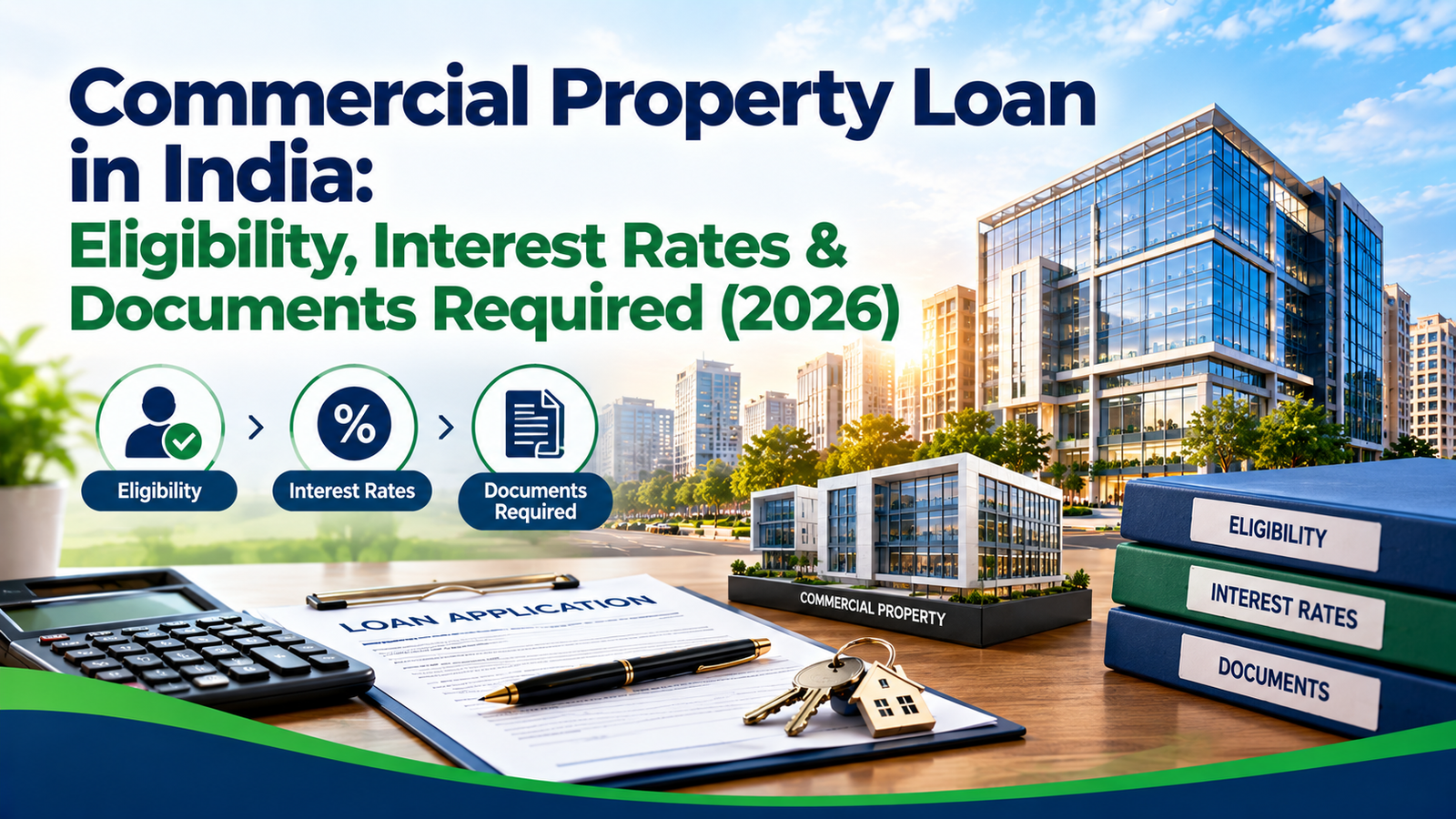
Buying a commercial property can be an important step for a business owner, investor, entrepreneur or professional looking to build long-term assets and generate rental income. However, commercial real estate often requires significantly more capital than residential property, which is why many buyers explore financing options such as a commercial property loan in India.
Whether you want to purchase an office, retail shop, showroom, warehouse, business centre or another eligible commercial property, understanding the loan process before making a purchase can help you plan your finances more effectively.
A commercial property loan can help reduce the upfront capital requirement, but lenders generally assess several factors before approving the loan. These may include the applicant’s income, credit profile, business history, property value, legal title, property usage, repayment capacity and the overall risk associated with the transaction.
If you are searching for commercial property loan eligibility, commercial property loan interest rates, documents required for commercial property loan, or the best loan for commercial property, this guide explains the key points you should know in 2026.
Quick answer: A commercial property loan is financing used to purchase or, depending on the product, finance an eligible commercial real estate asset. Approval generally depends on the borrower’s income and creditworthiness, the property’s legal and technical quality, loan-to-value considerations, and the lender’s internal policies.
What Is a Commercial Property Loan?
A commercial property loan in India is a secured financing facility used to purchase or finance eligible commercial real estate.
Depending on the lender and product, commercial property financing may be available for assets such as:
- Office spaces
- Retail shops
- Showrooms
- Commercial complexes
- Business centres
- Warehouses
- Industrial properties
- Clinics
- Certain specialised commercial properties
- Commercial units intended for business use
The exact property types accepted by a lender can differ.
Commercial property loans should also be distinguished from Loan Against Property (LAP).
A commercial property purchase loan is generally associated with financing the acquisition of a commercial asset, whereas LAP involves mortgaging an already-owned property to raise funds. LAP can sometimes be used for business purposes, subject to the lender’s conditions.
For example, ICICI Bank describes LAP as a secured facility against residential, commercial or industrial property, while its commercial-property purchase product for NRIs is specifically designed for purchasing commercial property for self-use.
Therefore, before applying, determine exactly which financing product matches your requirement.
Why Do Buyers Take Commercial Property Loans?
There are several reasons why investors and business owners consider commercial property financing.
1. Lower upfront capital requirement
Buying a commercial property entirely with personal funds can significantly reduce available working capital.
Financing allows the buyer to spread repayment over a longer period, subject to lender approval.
2. Business expansion
A business owner may purchase an office, showroom, clinic or commercial unit rather than continuing to pay rent.
3. Rental income strategy
An investor may purchase a commercial property and lease it to a tenant. However, rental income should never be assumed to automatically cover the EMI.
Vacancy, maintenance, taxes, tenant turnover and other costs must be considered.
4. Asset creation
Instead of paying rent indefinitely, a business may choose to acquire an asset that can potentially retain or increase in value over the long term.
5. Leverage
Property financing allows an investor to control a larger asset with a combination of equity and borrowed capital.
However, leverage also increases financial risk.
Commercial Property Loan Interest Rate in India 2026
One of the most searched questions is:
What is the commercial property loan interest rate in India in 2026?
There is no single interest rate applicable to every borrower.
The final rate can depend on:
- Lender
- Loan type
- Borrower profile
- Credit score
- Income
- Business vintage
- Property type
- Property location
- Loan amount
- Loan tenure
- Existing relationship with the lender
- Security offered
- Repayment capacity
- Internal credit assessment
Current publicly available 2026 market information for mortgage/LAP products shows substantial variation between lenders. For example, BankBazaar’s October 2026 mortgage-loan comparison lists rates from around 8.20% p.a. for some lenders and higher rates for others, while its LAP comparison also shows lender-specific rates varying considerably. These figures are indicative and can change.
Therefore, instead of searching only for the phrase “lowest commercial property loan interest rate”, compare the complete borrowing cost.
Look at:
Interest rate + processing fee + valuation charges + legal charges + documentation charges + insurance requirements + prepayment terms + other applicable charges.
A slightly higher interest rate can sometimes be offset by lower fees or more suitable repayment terms, while a low advertised rate may not necessarily be available to every borrower.
Fixed vs Floating Interest Rate
Commercial property loans may be offered under different interest-rate structures depending on the lender and product.
Floating interest rate
The interest rate can change over the loan period based on the applicable benchmark and lender terms.
Advantages can include:
- Potential benefit if rates decline
- Flexibility in some loan structures
Risks include:
- EMI or repayment burden may increase
- Total interest cost can rise if rates increase
Fixed interest rate
The interest rate remains fixed for the applicable fixed-rate period or as defined in the loan agreement.
Advantages:
- Greater repayment predictability
- Easier financial planning
Potential disadvantage:
- You may not benefit immediately from falling market rates.
Always ask the lender whether the quoted rate is fixed, floating or fixed for a specific period before comparing offers.
Commercial Property Loan Eligibility in India
Commercial property loan eligibility varies between lenders.
However, lenders commonly assess the following factors.
1. Age of the applicant
Most lenders specify minimum and maximum age criteria.
The maximum permissible age may also be assessed at loan maturity rather than only at application.
For example, publicly available mortgage/LAP eligibility information commonly places applicant age ranges around the early 20s to 65–70 years, depending on lender and product.
Always verify the exact requirement with the lender.
2. Income
Income is one of the most important components of loan underwriting.
Lenders may consider:
- Salary
- Business income
- Professional income
- Rental income
- Existing liabilities
- Banking transactions
- Tax returns
- Financial statements
A higher and more stable income can improve repayment capacity.
3. Employment or business stability
Salaried applicants may need evidence of employment stability.
Self-employed applicants and business owners may need to demonstrate business continuity and consistent financial performance.
Some commercial-loan documentation requirements include multiple years of income-tax returns and financial statements.
4. Credit score
Your credit history can significantly influence loan approval and pricing.
A strong credit profile indicates a history of responsible borrowing and repayment.
There is no universal credit-score threshold for every commercial property loan, but lenders generally prefer stronger credit profiles.
Before applying:
- Check your credit report
- Clear overdue payments
- Reduce unnecessary outstanding debt
- Avoid multiple loan applications within a short period
- Correct errors in your credit report
5. Existing financial obligations
The lender will evaluate your current EMIs and other liabilities.
For example, if an applicant already has several business loans, personal loans and credit-card obligations, the lender may reduce the additional loan amount it is willing to approve.
6. Property value
The property itself serves an important role in secured financing.
The lender may conduct:
- Technical valuation
- Legal verification
- Title examination
- Location assessment
- Building approval verification
- Market-value assessment
The approved loan may represent only a portion of the property’s accepted value.
For example, HDFC Bank’s business-focused LAP guidance states that loan amounts can be influenced by property value and discusses lending of up to 65% of estimated property value in its example.
The actual LTV offered for a particular commercial property loan can be different.
Who Can Apply for a Commercial Property Loan?
Depending on the lender and product, eligible applicants may include:
- Salaried individuals
- Self-employed professionals
- Business owners
- Sole proprietors
- Partnership firms
- LLPs
- Private limited companies
- Public companies
- Trusts
- HUFs
- Other eligible legal entities
Axis Bank’s current commercial-loan FAQ, for example, lists self-employed professionals, proprietors, partnership firms, companies, LLPs, HUFs, trusts and other entities among potential commercial-loan applicants, subject to product requirements.
The exact eligibility depends on the product selected.
Documents Required for Commercial Property Loan
One of the most important parts of the application is preparing the commercial property loan documents.
The exact checklist varies by lender, borrower type and property.
However, applicants should generally prepare the following categories.
1. Identity documents
Common documents include:
- PAN Card
- Aadhaar Card
- Passport
- Voter ID
- Driving licence
- Other acceptable KYC documents
2. Address proof
Depending on lender requirements:
- Aadhaar
- Passport
- Driving licence
- Utility bill
- Voter ID
- Property-tax receipt
- Other accepted address documents
3. Income documents for salaried applicants
These may include:
- Salary slips
- Form 16
- Income-tax returns where applicable
- Bank statements
- Employment information
4. Income documents for self-employed applicants
Self-employed applicants may need:
- Income-tax returns
- Computation of income
- Profit and loss statements
- Balance sheets
- Bank statements
- GST returns where applicable
- Business proof
- Business profile
- Other financial documents
Some lender checklists require multiple years of financial statements for self-employed applicants.
Business Documents Required
If the borrower is a company or partnership, additional documents may be required.
These can include:
- Certificate of incorporation
- Memorandum of Association
- Articles of Association
- Partnership deed
- LLP agreement
- GST registration
- Business registration documents
- Board resolution
- List of directors
- Shareholding pattern
- Business address proof
- Relevant licences
Axis Bank’s commercial-loan documentation guidance includes business constitution documents, incorporation documentation, tax returns, financial statements and property title/lease documents.
Property Documents Required for Commercial Property Loan
This is one of the most important parts of the application.
The lender generally needs evidence that the property has clear and acceptable ownership.
Depending on the transaction, documents may include:
- Sale deed
- Agreement to sell
- Title deed
- Mother deed
- Registration documents
- Allotment letter
- Possession letter
- Lease deed, where applicable
- Property-tax receipts
- Approved building plan
- Completion certificate
- Occupancy certificate, where applicable
- Encumbrance-related documents
- NOCs
- Society or association documents, where applicable
- Approved land-use documentation
- Existing loan/mortgage details, if applicable
The lender may also require additional documentation following legal and technical verification.
How Banks Evaluate a Commercial Property
Getting a commercial property loan is not only about proving your income.
The lender also needs to be comfortable with the property being offered or purchased.
Legal verification
The lender may examine:
- Ownership
- Title chain
- Encumbrances
- Registration
- Land-use permissions
- Existing charges
- Approvals
- Litigation-related issues
Technical verification
The property may be assessed for:
- Location
- Construction quality
- Building condition
- Area
- Approved plan
- Usage
- Market value
- Accessibility
HDFC Bank’s mortgage documentation also emphasizes clear and marketable title, absence of encumbrances and compliance with applicable permissions and building plans.
This is why buyers should complete independent legal due diligence rather than relying exclusively on the lender’s verification.
How Much Commercial Property Loan Can You Get?
There is no universal maximum amount.
The approved loan amount can depend on:
- Property value
- LTV policy
- Applicant income
- Existing debt
- Credit score
- Business cash flow
- Property type
- Location
- Loan purpose
- Lender’s internal risk policy
For example, a ₹2 crore commercial property does not automatically qualify for a ₹1.5 crore loan.
If a lender accepts a lower LTV based on the property and borrower profile, the required down payment will be higher.
Commercial Property Loan EMI Calculation
Before taking a loan, calculate your expected EMI.
For an illustrative example, suppose you borrow:
Loan amount: ₹1 crore
Interest rate: 9.5% p.a.
Tenure: 15 years
The approximate EMI would be around ₹1.04 lakh per month.
This is only an illustration. The actual EMI depends on the sanctioned rate, loan amount, tenure, repayment structure and lender’s terms.
Do not assess affordability only by asking:
“Can I pay this EMI?”
Also ask:
- What happens if the property remains vacant?
- Can the business survive a temporary revenue decline?
- What happens if interest rates rise?
- Can I maintain six to twelve months of repayment reserves?
- What are the property’s maintenance costs?
- What other business liabilities do I have?
Commercial Property Loan vs Loan Against Property
These two products are frequently confused.
| Factor | Commercial Property Loan | Loan Against Property |
|---|---|---|
| Main purpose | Purchase/finance eligible commercial property | Raise funds against owned property |
| Security | Usually the financed property | Existing property |
| Property type | Depends on lender | Residential/commercial/industrial depending on lender |
| Use of funds | Usually linked to stated property purpose | Can be more flexible subject to lender |
| Documentation | Income + property + transaction documents | Income + ownership + property documents |
| Approval | Based on borrower and property | Based on borrower, property and purpose |
| Tenure | Product-specific | Product-specific |
ICICI Bank states that LAP can be secured against residential, commercial or industrial property, while its commercial-property purchase offering is structured separately.
If you already own a commercial property and want to raise funds against it, ask lenders specifically about LAP or specialised-property financing rather than assuming a purchase loan is appropriate.
Loan Against Commercial Property for Business
Business owners sometimes choose loan against commercial property when they already own an office, shop, warehouse or other eligible commercial asset.
The money may potentially be used for purposes such as:
- Business expansion
- Working capital
- Equipment purchase
- Renovation
- New branch expansion
- Business consolidation
However, the permitted end-use depends on the lender and product.
HDFC Bank describes LAP as a secured business-financing option where property can be used as collateral for purposes such as business expansion and infrastructure upgrades.
Lease Rental Discounting: Another Option for Commercial Property Owners
If you already own a rented commercial property, Lease Rental Discounting (LRD) may be another financing route to investigate.
LRD is designed around rental income generated by an eligible leased commercial or specialised property.
ICICI Bank states that its LRD facility is available to eligible resident and non-resident individuals and can have a tenure of up to 15 years for commercial and specialised properties, subject to the lease and lender conditions. It also requires rental inflows to be routed through an escrow arrangement.
LRD can therefore be particularly relevant for owners who already have:
- A leased commercial property
- A registered lease
- Consistent rental income
- A tenant with an acceptable profile
Again, eligibility and terms vary by lender.
Step-by-Step Commercial Property Loan Process
1: Define your requirement
Decide whether you want to:
- Purchase a commercial property
- Purchase an office for self-use
- Purchase a retail shop
- Buy a showroom
- Finance a warehouse
- Raise funds against an existing property.
2: Check your eligibility
Review:
- Income
- Credit score
- Existing EMIs
- Business vintage
- Property value
- Down-payment capacity
3: Shortlist the property
Evaluate:
- Location
- Price
- Floor
- Visibility
- Parking
- Access
- Rental demand
- Tenant profile
- Developer
- Project approvals
4: Compare lenders
Do not compare only interest rates.
Compare:
- Interest rate
- Processing fee
- Loan tenure
- LTV
- Prepayment rules
- Legal charges
- Valuation charges
- Documentation charges
- Insurance requirements
- Other fees
5: Submit documents
Prepare your KYC, income, business and property documents.
Incomplete documentation can delay the process.
6: Legal and technical verification
The lender may conduct property verification and valuation.
7: Loan sanction
If the lender approves the application, you receive the sanction terms.
Read the sanction letter carefully.
Check:
- Loan amount
- Interest rate
- Tenure
- EMI
- Processing fee
- Conditions
- Security
- Other charges
8: Agreement and mortgage
After satisfying applicable conditions, the lender completes the loan documentation and security creation.
9: Disbursement
Funds are released according to the lender’s disbursement conditions.
For a property purchase, disbursement may be linked to the transaction and required documentation.
How to Improve Your Chances of Commercial Property Loan Approval
Maintain a strong credit profile
Pay existing EMIs and credit-card dues on time.
Keep financial statements organised
For business owners, clean accounting records can make underwriting easier.
Maintain sufficient banking history
Consistent banking transactions help demonstrate cash flow.
Reduce unnecessary debt
A high debt burden can reduce borrowing capacity.
Choose a legally clean property
Properties with unclear title, approval issues or unresolved encumbrances can create problems.
Keep your down payment ready
Do not assume that the lender will finance the entire purchase price.
Avoid excessive loan applications
Multiple applications can result in multiple credit enquiries.
Common Mistakes to Avoid
1. Choosing a property only because it is cheap
A low price does not necessarily mean a good investment.
Commercial property depends heavily on demand, accessibility, visibility and tenant potential.
2. Looking only at EMI
A low EMI achieved through a long tenure may result in a higher total interest cost.
3. Ignoring vacancy risk
If you are buying for rental income, calculate how you would manage a vacancy period.
4. Not checking the lease
For pre-leased commercial property, carefully examine the lease agreement.
5. Ignoring property approvals
Make sure the property is legally suitable for your intended use.
6. Assuming advertised rental yield is guaranteed
Rental yield is an estimate based on actual rent and total acquisition cost.
7. Ignoring maintenance costs
Commercial buildings may involve common-area maintenance, property tax, repairs, facility charges and other expenses.
8. Borrowing more than necessary
Higher leverage increases financial risk.
Is Commercial Property Loan a Good Idea in 2026?
A commercial property loan can be useful when the property, financing cost and repayment capacity make financial sense.
The decision becomes particularly important in growing commercial markets such as Lucknow.
Mozart Realty’s current commercial-property research identifies Gomti Nagar, Gomti Nagar Extension, Shaheed Path, Ekana Sportz City, Hazratganj and Kanpur Road among the city’s important commercial corridors, with the investment proposition varying by property type and location.
For example:
Gomti Nagar
Suitable opportunities can include:
- Offices
- Retail
- Banks
- Premium commercial spaces
Gomti Nagar Extension
Potentially relevant for:
- New commercial developments
- Retail
- Offices
- Food and lifestyle businesses
Shaheed Path
Can be considered for:
- Offices
- Showrooms
- Logistics
- Commercial developments
Hazratganj
Known for established high-street commercial activity and premium retail positioning.
Sushant Golf City
Can offer opportunities linked to the surrounding residential, healthcare, hospitality and commercial ecosystem.
However, locality alone does not make a property a good investment.
The specific unit, floor, price, tenant demand, parking, visibility, approvals and financing cost still matter.
Commercial Property Loan Checklist for Buyers
Before signing the loan documents, ask yourself:
Borrower checklist
- Is my credit score healthy?
- Is my income stable?
- Have I disclosed all existing loans?
- Can I comfortably pay the EMI?
- Do I have an emergency repayment reserve?
Property checklist
- Is the title clear?
- Is the property legally approved?
- Is commercial use permitted?
- Are applicable RERA details verified?
- Are building approvals available?
- Is the property free from undisclosed encumbrances?
- Has the property been independently checked?
Loan checklist
- What is the actual interest rate?
- Is it fixed or floating?
- What is the total processing fee?
- What is the tenure?
- What is the EMI?
- What is the total interest payable?
- Are there prepayment or foreclosure charges?
- Are valuation and legal charges extra?
- What happens if interest rates change?
Frequently Asked Questions
What is a commercial property loan?
A commercial property loan is financing used to purchase or finance an eligible commercial real estate asset, subject to the lender’s product terms and eligibility criteria.
What is the commercial property loan interest rate in India in 2026?
There is no single rate. Current public lender comparisons show significant variation depending on lender, product, borrower profile, property and creditworthiness. Applicants should obtain a personalised quotation rather than relying on a generic online rate.
What documents are required for a commercial property loan?
Common documents include KYC documents, income proof, bank statements, tax returns, business documents and property documents such as sale deeds, title documents, approvals and tax records.
Can self-employed people get commercial property loans?
Yes, eligible self-employed professionals and business owners can apply for applicable commercial-property financing, subject to lender requirements.
Can I get a loan against commercial property?
Yes. Several lenders offer Loan Against Property or specialised-property financing against eligible commercial assets. The property must satisfy the lender’s legal, technical and valuation requirements.
How much loan can I get against commercial property?
The amount depends on the property’s accepted value, applicable LTV, borrower income, credit profile, repayment capacity and lender policy.
Can I use a commercial property loan for rental investment?
Depending on the lender and product, commercial property financing can be used to purchase eligible investment property. However, lenders may have different end-use and eligibility requirements.
Is commercial property financing better than paying cash?
Not necessarily. Financing can preserve capital and provide leverage, but it creates interest obligations and financial risk. The right choice depends on the property’s expected cash flow, your cost of capital and repayment capacity.
How Mozart Realty Can Help With Commercial Property Investment in Lucknow
Finding the right commercial property is only one part of the investment decision.
The financing structure also matters.
At Mozart Realty, buyers and investors can explore commercial property opportunities across Lucknow and evaluate properties based on location, investment objective, rental potential, property type and overall suitability.
Mozart Realty’s current commercial-property research covers locations including Gomti Nagar, Gomti Nagar Extension, Shaheed Path, Ekana Sportz City, Hazratganj and Kanpur Road. The company also provides guidance around property sourcing, investment evaluation, RERA-related checks and due diligence.
If you are planning to finance a commercial property, the ideal approach is to evaluate property + loan + cash flow together rather than treating the property purchase and loan as separate decisions.
Conclusion
A commercial property loan in India can make it easier for investors and business owners to acquire commercial real estate without deploying the entire purchase amount from their own capital.
But successful commercial property financing requires more than finding the lowest advertised interest rate.
You should evaluate:
- Commercial property loan eligibility
- Interest rate
- Loan-to-value ratio
- Down payment
- EMI
- Total borrowing cost
- Credit profile
- Income stability
- Business performance
- Property title
- Property approvals
- Location
- Rental potential
- Vacancy risk
- Exit potential
The most important principle is simple:
Do not choose the loan first and then find a property that fits it. Choose a fundamentally suitable property, calculate the required financing, and then select the loan structure that fits your financial capacity.
For investors considering commercial property in Lucknow, locations such as Gomti Nagar, Gomti Nagar Extension, Shaheed Path, Sushant Golf City and other established or emerging commercial corridors can offer different opportunities depending on the asset type and investment objective.
A well-researched commercial property combined with manageable leverage, adequate cash reserves and proper legal due diligence can create a more sustainable long-term investment strategy.
Disclaimer
This article is for general informational and educational purposes only and does not constitute financial, legal, tax or investment advice. Commercial property loan interest rates, eligibility, LTV, fees, tenure and documentation requirements vary by lender and borrower profile and may change without notice. Property values, rental income and investment returns are not guaranteed. Always verify the latest terms directly with the relevant lender and obtain independent legal and financial advice before making a property or borrowing decision.


Join The Discussion