
Introduction
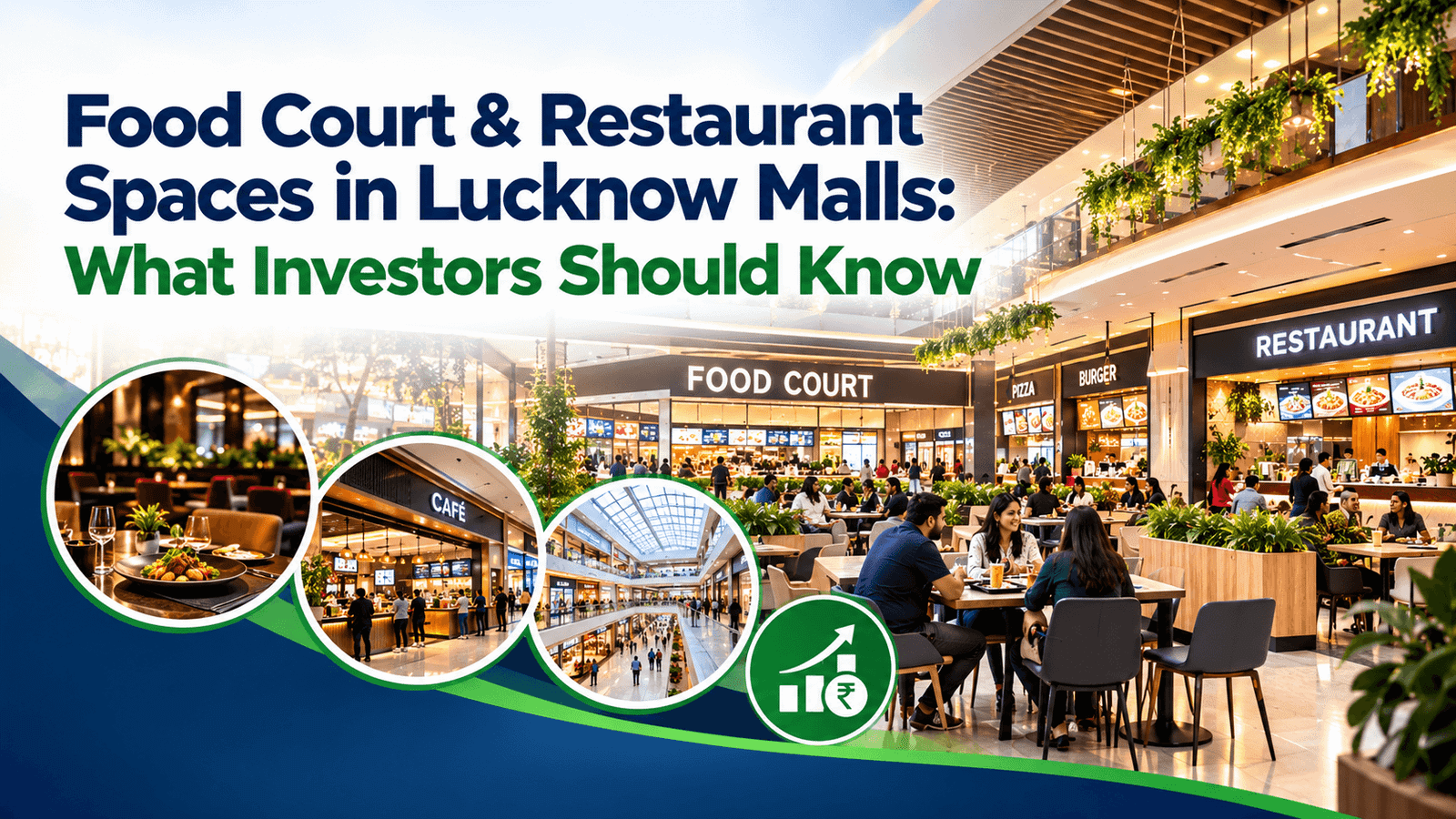
The food and beverage (F&B) industry is an important part of the commercial real estate ecosystem. Shopping malls, mixed-use developments, entertainment destinations, and high-street commercial projects increasingly combine retail, dining, leisure, and office spaces to create destinations where people can spend more time.
For property investors and entrepreneurs, this creates an opportunity to explore food court spaces in Lucknow as a commercial investment or business location.
Lucknow’s evolving retail landscape includes established shopping destinations, growing commercial corridors, residential townships, and mixed-use developments. Areas such as Gomti Nagar, Gomti Nagar Extension, Shaheed Path, and Sushant Golf City have become relevant to investors evaluating retail and food-related commercial opportunities.
The city’s food culture also provides a distinctive backdrop for F&B businesses. Traditional Awadhi cuisine, modern cafés, quick-service restaurants (QSRs), family dining, and national food brands serve different customer segments. A well-positioned food outlet can benefit from a combination of local residents, office workers, shoppers, visitors, and entertainment seekers.
However, investing in a food court or restaurant space is not as simple as purchasing a commercial unit and expecting rental income. The investment outcome depends on location, visibility, customer catchment, tenant quality, operating costs, lease structure, and the property’s suitability for food operations.
A busy mall does not automatically guarantee a profitable food outlet, and a high advertised rental yield does not necessarily mean a low-risk investment.
This guide explains what investors should know before purchasing, leasing, or operating food court and restaurant spaces in Lucknow malls in 2026.
What Is a Food Court Commercial Space?
A food court is a designated dining area within a shopping mall, commercial complex, airport, office development, or mixed-use destination. It generally contains multiple food outlets that share common seating and customer facilities.
Unlike a standalone restaurant, a food court outlet may benefit from shared infrastructure such as:
- Common dining areas
- Centralised seating
- Shared washrooms
- Mall security
- Common-area maintenance
- Parking facilities
- Customer circulation
- Mall-level promotions
- Shared utilities, depending on the agreement
Food court spaces may be offered as individual units, kiosks, counters, or dedicated food and beverage outlets.
They are commonly suitable for:
- Quick-service restaurants
- Cafés
- Fast-food brands
- Dessert outlets
- Juice and beverage counters
- Regional food brands
- Franchise businesses
- Takeaway concepts
- Casual dining formats
The exact permitted use depends on the project’s design, approvals, lease terms, and operating rules.
Food Court vs Restaurant Space
A food court and a restaurant are not identical investment products.
| Factor | Food Court Outlet | Standalone or Dedicated Restaurant |
|---|---|---|
| Seating | Often shared | Usually dedicated |
| Customer source | Mall or complex visitors | Destination and local customers |
| Visibility | Depends on floor and placement | Depends on frontage and signage |
| Infrastructure | May share facilities | More independent |
| Operating rules | Mall-specific | Property and local regulations |
| Investment structure | Unit purchase, lease, or concession | Purchase or lease |
| Customer experience | Shared dining environment | Brand-controlled environment |
| Operating costs | May include common-area charges | Depends on property |
| Suitable business | QSR, kiosk, casual dining | Cafés, family restaurants, premium dining |
Investors should compare the total occupancy cost and expected sales potential rather than assuming one format is inherently more profitable.
Why Are Food Court Spaces Attracting Investor Interest in Lucknow?
Lucknow’s commercial development is creating opportunities for different retail and F&B formats.
Mozart Realty’s commercial property research identifies food court and F&B units as a distinct category within the city’s commercial investment landscape. Its 2026 research lists indicative rental-yield estimates for food court and F&B units in selected mixed-use developments, while emphasising that actual returns depend on the property and investment structure. These estimates should be treated as market guidance rather than guaranteed income.
Several factors contribute to interest in this segment.
Growing Mixed-Use Developments
Modern commercial projects increasingly combine retail shops, offices, food courts, entertainment, and other facilities.
This creates multiple potential customer groups within one development. Office employees may visit food outlets during working hours, while shoppers and residents may contribute to evening and weekend demand.
Demand for Convenient Dining
Customers often value convenient dining options near shopping, work, entertainment, and residential destinations.
Food courts can serve customers looking for quick meals, family dining, snacks, and informal gatherings.
Opportunities for Established and Emerging Brands
Food court formats can accommodate both recognised brands and smaller food businesses, subject to the operator’s requirements and the project’s leasing policies.
Multiple Investment Models
Investors may consider:
- Purchasing a food court unit and leasing it to an operator.
- Purchasing a unit and operating an F&B business.
- Leasing a unit to a franchise brand.
- Investing through a revenue-sharing arrangement.
- Purchasing a commercial unit in a project with dedicated food court facilities.
Each model has a different risk and return profile.
Best Locations to Explore for Food Court and Restaurant Investment in Lucknow
Location is one of the most important factors in F&B real estate. A restaurant needs more than a good address; it needs a relevant customer catchment, convenient access, visibility, and an operating environment suited to its concept.
The following areas are worth evaluating based on the type of food business or investment.
Gomti Nagar
Gomti Nagar is an established commercial and residential district with offices, retail destinations, hotels, professional services, and dining options.
Potential F&B formats include:
- Cafés
- Casual dining
- Premium restaurants
- QSR outlets
- Dessert brands
- Corporate lunch concepts
- Family restaurants
The area’s established commercial ecosystem may provide access to multiple customer groups. However, investors should evaluate competition, rent, parking, and the exact micro-location.
Gomti Nagar Extension
Gomti Nagar Extension is associated with newer residential and commercial development.
Potential opportunities may include neighbourhood cafés, casual dining, quick-service food outlets, and restaurants serving nearby residents and professionals.
Investors should assess the maturity of the surrounding catchment, actual occupancy, accessibility, and the number of competing food outlets.
Shaheed Path
Shaheed Path is a major connectivity corridor with residential, institutional, healthcare, hospitality, and commercial activity.
The wider corridor includes developments around Sushant Golf City and other mixed-use commercial destinations.
Food-related businesses may benefit from a combination of local residents, office users, visitors, and customers travelling through the area.
However, a property’s proximity to a major road does not automatically guarantee walk-in customers. Access roads, parking, signage, visibility, and ease of entry must be verified.
Sushant Golf City
Sushant Golf City is relevant for investors exploring commercial opportunities within a developing residential and mixed-use ecosystem.
Possible F&B formats include:
- Family dining
- Cafés
- QSR outlets
- Dessert shops
- Takeaway businesses
- Food court counters
- Delivery-oriented kitchens
The investment case should be based on the exact project’s operating status, surrounding occupancy, tenant mix, and customer movement.
Hazratganj and Central Lucknow
Hazratganj has an established commercial identity and is relevant for businesses seeking a central address.
It may suit premium cafés, restaurants, dessert brands, and destination dining concepts.
Investors should carefully evaluate property age, parking, building permissions, operating restrictions, and acquisition cost.
Emerging Commercial Hubs
New commercial developments around residential communities, offices, hospitals, and entertainment destinations may offer opportunities for F&B businesses.
The most important question is whether the surrounding customer base is already active or still dependent on future development.
Investors should not base a purchase entirely on projected footfall.
What Makes a Food Court Location Valuable?
A food court’s commercial potential depends on several interconnected factors.
A. Relevant Footfall
Footfall is often one of the first numbers mentioned in commercial property marketing.
However, relevant footfall matters more than headline footfall.
For example, a food outlet serving office workers may benefit from weekday lunch traffic, while a family restaurant may depend more on evenings and weekends.
Investors should ask:
- Who visits the property?
- What is the average customer profile?
- What are the busiest hours?
- How many visitors actually enter the food court?
- Is traffic driven by shoppers, employees, residents, or events?
- Are customers likely to purchase food?
- How does footfall change across weekdays and weekends?
Where possible, request documented footfall information and independently observe customer movement.
B. Visibility
An outlet that is easy to notice may have an advantage over one hidden behind corridors or poorly positioned entrances.
Important factors include:
- Signage
- Entrance visibility
- Directional signs
- Floor location
- Proximity to escalators and lifts
- Customer circulation
- Visibility from common seating areas
C. Accessibility
Customers should be able to reach the food court without unnecessary difficulty.
Evaluate:
- Road connectivity
- Parking
- Pedestrian access
- Entry and exit points
- Lift and escalator access
- Public transport
- Delivery access
- Accessibility for families and older customers
D. Tenant Mix
A balanced tenant mix can make a food court more appealing.
For example, a combination of Indian meals, snacks, beverages, desserts, and quick-service options can serve different customer preferences.
However, too many outlets offering similar products may create direct competition.
E. Seating and Cleanliness
Customers often evaluate a food court as a complete experience rather than judging only the individual outlet.
Clean seating, washrooms, waste management, ventilation, and common-area maintenance can influence repeat visits.
Investors should understand who is responsible for these facilities and how their costs are shared.
Food Court Investment: Ownership vs Operating a Restaurant
This is one of the most important decisions for investors.
Purchasing a food court unit and operating a restaurant are two different activities.
Model 1: Buy the Unit and Lease It to a Food Business
Under this model, the investor owns the commercial property and rents it to a restaurant, café, franchise, or food operator.
Potential advantages:
- Rental income
- Less direct involvement in restaurant operations
- Opportunity to lease to established brands
- Potential property appreciation
- Ability to evaluate the tenant and lease before purchasing
Potential risks:
- Vacancy
- Tenant default
- Lease renewal risk
- Fit-out and restoration obligations
- Dependence on the mall’s performance
- Maintenance and common-area charges
The investor should review the lease carefully, including rent, escalation, lock-in, security deposit, permitted use, maintenance, and termination terms.
Model 2: Buy the Unit and Operate the Restaurant
Under this model, the investor owns the property and runs the F&B business.
Potential advantages:
- Control over business operations
- Potential profit from food sales
- Ability to build a brand
- Multiple revenue streams
Potential risks:
- Staff management
- Food wastage
- Inventory costs
- Marketing expenses
- Customer acquisition
- Operating losses
- Food safety compliance
- Equipment maintenance
- Changing consumer preferences
This model requires hospitality or restaurant-management expertise. Owning the property does not guarantee that the restaurant itself will be profitable.
Model 3: Lease to a Franchise Brand
An investor may lease the space to a franchise operator or brand.
The arrangement can provide a structured tenant relationship, but the investor should verify the actual contracting entity, franchise rights, lease obligations, and financial capacity.
A brand’s reputation should not replace due diligence on the tenant who signs the lease.
How to Calculate ROI on Food Court Property
Investors should calculate returns using the total acquisition cost and realistic rental assumptions.
Gross Rental Yield Formula
Gross Rental Yield = Annual Rental Income ÷ Total Property Cost × 100
Consider this illustrative example:
- Purchase price: ₹60 lakh
- Monthly rent: ₹40,000
- Annual rent: ₹4,80,000
Gross yield:
₹4,80,000 ÷ ₹60,00,000 × 100
= 8% gross rental yield
This is an illustrative calculation, not a market quote or guaranteed return.
Net Rental Yield
Suppose annual property-related expenses are ₹60,000.
Net operating income:
₹4,80,000 − ₹60,000 = ₹4,20,000
Net yield:
₹4,20,000 ÷ ₹60,00,000 × 100
= 7% net yield
Actual expenses may include:
- Maintenance
- Property tax
- Insurance
- Repairs
- Brokerage
- Vacancy
- Legal fees
- Management charges
- Common-area expenses
- Financing costs
Investors should also include registration, stamp duty, fit-out, and other acquisition expenses when calculating the total investment.
What About Revenue Sharing?
Some F&B arrangements use a minimum guarantee, revenue share, or a combination of both.
For example, an agreement may specify a fixed minimum payment plus a percentage of sales above a defined threshold.
Such arrangements require careful review of:
- Sales reporting
- Audit rights
- Payment timelines
- Minimum guarantee
- Revenue-share percentage
- Taxes
- Common-area charges
- Business closure provisions
Do not compare a revenue-sharing agreement directly with a fixed-rent lease without modelling the possible outcomes.
Hidden Costs Investors Must Consider
A food court unit can appear attractive on the basis of its purchase price and advertised rent, but additional expenses can materially affect the investment.
Common-Area Maintenance
Malls and commercial complexes may charge maintenance for shared facilities.
Clarify whether the owner or tenant pays these charges and whether they can increase over time.
Fit-Out Costs
Restaurant operations may require:
- Kitchen equipment
- Exhaust systems
- Fire safety equipment
- Plumbing
- Electrical upgrades
- Flooring
- Furniture
- Signage
- Interior work
The responsibility for fit-out costs should be defined in the lease or purchase agreement.
Utilities
Food businesses can have significant electricity and water requirements.
Confirm the availability and capacity of the relevant infrastructure.
Waste Management
Food operations generate wet waste, packaging, and other refuse.
Understand the property’s waste-handling system and the operator’s responsibilities.
Repairs and Replacement
Air conditioning, refrigeration, kitchen equipment, plumbing, and electrical systems may require ongoing maintenance.
Vacancy and Tenant Turnover
Even a well-located unit may experience vacancy between tenants.
Include a realistic vacancy allowance in your financial model.
Legal and Regulatory Checks Before Investing
Food court and restaurant properties require both real estate due diligence and business-use verification.
Property-Level Checks
Review:
- Ownership and title
- Encumbrance status
- Approved building plans
- Occupancy or completion documentation, where applicable
- Commercial-use permissions
- Project approvals
- Lease restrictions
- Maintenance dues
- Property tax records
- Fire and safety provisions
Food Business Compliance
Depending on the business and premises, operators may need to comply with requirements relating to:
- FSSAI registration or licensing
- Local trade permissions
- Fire safety
- Waste disposal
- Shops and Establishments requirements
- GST, where applicable
- Labour regulations
- Signage permissions
- Health and hygiene standards
The investor should confirm which obligations belong to the property owner and which belong to the restaurant operator.
For projects requiring registration under applicable real estate regulations, verify the relevant details directly through UP RERA rather than relying only on marketing material.
How to Evaluate a Mall Before Buying a Food Court Unit
A food court depends partly on the overall performance of the destination in which it is located.
Before investing, examine the mall or commercial complex itself.
Check the Operating Status
Is the project fully operational, partially occupied, or still under development?
A proposed food court and a functioning food court are not equivalent investment opportunities.
Review Occupancy
Ask for the occupancy status of retail shops, offices, entertainment facilities, and other commercial areas.
Study the Tenant Mix
A mix of recognised brands, local businesses, services, and entertainment may create different reasons for customers to visit.
Observe Footfall
Visit at different times:
- Weekday mornings
- Weekday evenings
- Weekends
- Holidays
- Event days
Observe actual customer movement rather than relying only on promotional claims.
Understand the Marketing Plan
Ask how the mall attracts visitors.
Does it conduct events? Does it promote tenant offers? Does it have a digital marketing strategy? Are there partnerships with entertainment or retail brands?
Examine the Food Court’s Position
A food court located in a low-traffic section may perform differently from one near a major circulation route or entertainment anchor.
The exact unit’s position matters.
Food Court vs High-Street Restaurant Investment
Investors may also compare mall food court units with standalone or high-street restaurant spaces.
| Factor | Mall Food Court | High-Street Restaurant |
|---|---|---|
| Customer source | Mall visitors | Local and destination customers |
| Visibility | Depends on internal placement | Road-facing visibility |
| Shared facilities | Often available | Usually more independent |
| Parking | Depends on mall | Depends on property |
| Operating restrictions | Mall-specific | Local property and regulatory rules |
| Customer experience | Shared environment | Greater brand control |
| Marketing | Mall and tenant activity | Primarily business-led |
| Costs | Rent plus applicable common charges | Rent and property-specific expenses |
| Suitable format | QSR, cafés, counters | Cafés, casual and full-service dining |
A mall location may provide access to an established visitor ecosystem, while a high-street property may offer greater independence and direct visibility.
The right choice depends on the business concept and the actual commercial terms.
Is a Food Court Unit Suitable for Passive Income?
A food court unit can be considered for rental income if it is leased to a capable operator under a well-structured agreement.
However, passive income does not mean zero risk or zero involvement.
The property owner may still need to:
- Monitor rent payments
- Manage lease renewals
- Resolve maintenance issues
- Review tenant compliance
- Handle disputes
- Plan for vacancy
- Maintain the property
- Track market rent
If the investor operates the restaurant personally, the investment is no longer passive in the conventional rental-property sense. It becomes an active business with operational responsibilities.
Investors seeking relatively low involvement should generally evaluate a tenant-led rental model and understand the lease obligations before purchasing.
Common Mistakes Investors Should Avoid
1: Buying Only Because the Project Is in a Mall
A mall’s reputation does not guarantee the success of every unit.
The specific floor, location, visibility, tenant mix, and access matter.
2: Assuming High Footfall Means High Sales
Visitors may not belong to the target customer segment or may not enter the food court.
Evaluate relevant footfall and conversion potential.
3: Ignoring Common-Area Charges
Maintenance and other charges can reduce net rental yield.
4: Overlooking Kitchen Infrastructure
A unit may be unsuitable for certain food concepts if it lacks required exhaust, drainage, power, or ventilation provisions.
5: Relying on Guaranteed Return Claims
Treat guaranteed rental or appreciation claims cautiously. Verify the contractual source, conditions, duration, and financial capacity of the party making the promise.
6: Ignoring Tenant Quality
A strong location cannot fully compensate for an unreliable tenant.
7: Not Checking Exit Potential
Ask who might buy the unit if you decide to sell.
A property with limited alternative uses may have a smaller resale market.
8: Underestimating Operating Costs
For investors operating restaurants, food costs, salaries, marketing, delivery commissions, wastage, and equipment maintenance can materially affect profitability.
Who Should Consider Food Court and Restaurant Property Investment?
This segment may be relevant to different types of buyers.
Income-Focused Investors
Those seeking rental income may evaluate units that can be leased to established food operators.
F&B Entrepreneurs
Business owners may consider food court or restaurant spaces to launch or expand a food concept.
Franchise Operators
Franchisees may seek locations that match the brand’s customer profile, operational requirements, and financial model.
Commercial Property Investors
Investors diversifying beyond offices and conventional retail may consider F&B-oriented commercial assets.
Long-Term Investors
Buyers with a longer investment horizon may examine properties in established or developing commercial ecosystems, while accounting for vacancy, lease risk, and market uncertainty.
Each investor should match the investment structure to their capital, experience, and risk tolerance.
How Mozart Realty Can Help
Mozart Realty provides real estate advisory and property-related services across Lucknow and other markets.
For investors exploring food court space in Lucknow, the first step is to define the objective:
- Rental income
- Restaurant ownership
- Franchise expansion
- Commercial property diversification
- Long-term investment
- Business operations
Mozart Realty’s commercial property research covers key Lucknow corridors and different commercial property categories, including retail, office, and F&B spaces. The consultancy also highlights the importance of comparing property prices, rental potential, location, and investment costs before making a decision.
Prospective buyers should independently verify the property’s legal status, approvals, lease terms, tenant details, commercial feasibility, and complete cost structure before committing funds.
Frequently Asked Questions
Is food court space in Lucknow a good investment?
It can be suitable for investors who select an appropriate location, verify the project’s operating status, assess tenant demand, and calculate realistic net returns. No food court investment is automatically profitable.
What is the difference between buying a food court unit and opening a restaurant?
Buying a food court unit for rental income is primarily a property investment. Operating a restaurant is an active business that involves staff, inventory, food safety, marketing, and daily operations.
Which areas of Lucknow should investors explore for food court spaces?
Gomti Nagar, Gomti Nagar Extension, Shaheed Path, Sushant Golf City, and selected central commercial areas may be worth examining. Suitability depends on the specific property, customer catchment, access, and business concept.
How do I calculate food court property ROI?
Calculate annual rental income divided by the total property investment, multiplied by 100. For a realistic result, deduct relevant expenses and consider vacancy, fit-out costs, and financing.
Is a food court better than a standalone restaurant?
Neither format is universally better. Food courts may benefit from shared facilities and destination traffic, while standalone restaurants may offer greater control over branding and customer experience. The economics depend on the specific location and agreement.
What should I check before purchasing a restaurant space?
Verify title, commercial-use permissions, building approvals, kitchen infrastructure, fire safety, exhaust provisions, maintenance obligations, parking, lease conditions, and the property’s suitability for the intended business.
Can I lease my food court unit to a franchise?
Potentially, subject to the project’s permitted use, the franchise operator’s requirements, and the lease agreement. Verify the tenant’s legal identity, financial capacity, and contractual obligations.
Does a high-footfall mall guarantee rental income?
No. Rental income depends on the lease, tenant’s financial health, customer demand, property suitability, and the mall’s operating performance. Footfall should be verified and evaluated for relevance.
Conclusion
Food court and restaurant spaces in Lucknow malls offer an interesting opportunity at the intersection of commercial real estate, retail, and the food and beverage industry.
The city’s evolving commercial corridors and mixed-use developments provide different settings for restaurants, cafés, QSR outlets, and food court businesses. Yet the investment outcome depends on more than the project’s location or advertised footfall.
Investors should evaluate the exact unit, customer catchment, tenant mix, visibility, access, kitchen infrastructure, lease terms, operating costs, and realistic rental income before making a decision.
For buyers seeking rental income, a well-structured lease with a capable operator may offer a different risk profile from directly running a restaurant. For entrepreneurs, the priority should be matching the space to the business concept and ensuring that operating costs remain sustainable.
Ultimately, the right food court investment is one where the property, customer demand, business model, and financial terms work together.
For professional guidance on commercial property opportunities in Lucknow, connect with Mozart Realty and conduct property-level due diligence before investing.
Disclaimer
This article is intended for general educational and informational purposes only and does not constitute financial, legal, tax, or investment advice. Property prices, rental yields, footfall, business performance, and future returns are not guaranteed. Readers should independently verify property documents, approvals, lease terms, costs, and commercial feasibility and consult qualified professionals before making an investment decision.



Join The Discussion